Heavy Is Safe: The Bone Density Case for Lifting More Than You Think You Should
Heavy Is Safe: The Bone Density Case for Lifting More Than You Think You Should
If you've been told to stick to light weights and high reps to protect your bones, here's what nobody mentioned: the LIFTMOR trial put postmenopausal women with diagnosed osteoporosis on heavy barbells at 85%+ of their maximum strength, and they gained 2-5% bone density at the spine and hips over eight months. Zero fractures. Zero injuries serious enough to stop training.
Meanwhile, the control group—who kept doing moderate-intensity, machine-based exercise—lost bone density.
The idea that heavy lifting is reckless for women over 50 is one of the most persistent and damaging myths in fitness. The research tells a different story: bone responds to mechanical load, and walking, yoga, and 3-pound dumbbells don't provide nearly enough of it. If you want to build or maintain bone density after menopause, you need to lift heavy things in ways that load your hips and spine. And 'heavy' doesn't mean what you think it means.
Why Walking Isn't Enough for Bone
Bone is living tissue. It adapts to the stress you put on it, and it atrophies when you don't. The technical term is Wolff's Law: bone grows stronger in response to the forces placed on it, and weaker in their absence.
Walking is great for cardiovascular health, balance, and mood. But the impact forces from walking are relatively small and repetitive—your skeleton adapts to them quickly and then stops responding. A 2025 meta-analysis of 17 resistance training trials found that weight-bearing cardio alone produced negligible bone density changes in postmenopausal women, while progressive strength training showed large effect sizes at the spine and hip.
To trigger new bone formation, you need to load your skeleton with forces it isn't already used to. That means compound lifts under a barbell: deadlifts, squats, presses. These exercises create axial loading—compression forces running through your spine and hips—that walking, cycling, and swimming simply can't replicate.
The LIFTMOR trial used deadlifts, back squats, and overhead presses as the backbone of the program. Participants lifted at 85% of their one-rep max or higher—meaning if they could deadlift 100 pounds once, they were training with 85+ pounds for reps. That's not light. That's not comfortable. And that's exactly why it worked.
What 'Heavy' Actually Means (and Why It's Relative)
When we say 'heavy,' we're not talking about an absolute number on the bar. We're talking about a percentage of your current maximum strength. Heavy for you might be 65 pounds. Heavy for someone else might be 165 pounds. Both are doing the same relative work.
A 2026 review of bone-loading studies confirmed what LIFTMOR demonstrated: training at 60-85% of max or higher produces the strongest dose-response for bone density. Anything lighter doesn't provide enough stimulus. Your bones need to feel challenged—not endangered, but challenged—to adapt.
Here's what that looks like in practice: if you can squat a weight for 10 reps, you're probably working at around 70-75% of your max. That's the zone. You finish the set and think, "I could maybe do one or two more, but not five." That's the load that builds bone.
The fear is that lifting this way is dangerous, especially if you're over 50 or have low bone density. The evidence says the opposite. The women in LIFTMOR had osteoporosis—diagnosed bone loss—and they trained at 85%+ for eight months without a single training-related fracture. They didn't get hurt because they were coached through proper setup, bracing, and progression. The weight was heavy, but the movement was sound.
Which Lifts Load the Hips and Spine (and Why That Matters)
Not all exercises create the kind of load bone needs. Bicep curls, leg extensions, and chest flies are fine for muscle, but they don't compress your skeleton in ways that trigger bone growth. For bone density, you need multi-joint, load-bearing movements that run force through your spine and hips.
The big three:
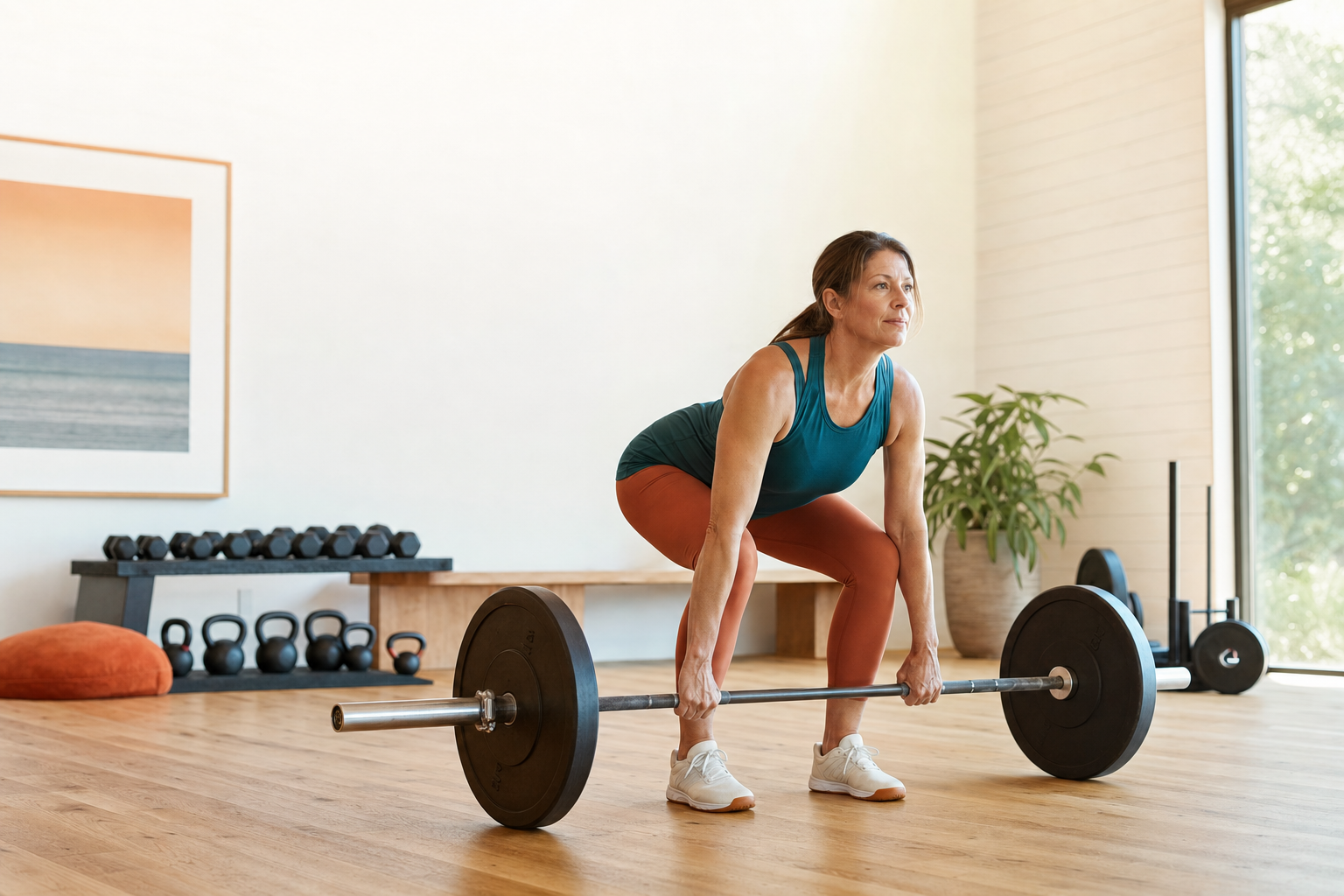
Deadlifts are the gold standard for hip and spine loading. You're picking a barbell off the floor while keeping your back neutral and your hips loaded. Done correctly, the deadlift creates compressive and tensile forces through your entire posterior chain—exactly the kind of stress bone responds to.
Squats load the spine vertically and challenge the hips in flexion and extension. Whether you're front-squatting, back-squatting, or goblet-squatting, you're teaching your body to handle load in a functional range of motion.
Overhead presses load the spine while your arms work overhead. This pattern is underrated for bone health—many people stop pressing overhead as they age, which accelerates shoulder and upper-spine weakness.
These are the lifts the LIFTMOR and ONERO trials used. They're not exotic. They're not dangerous when coached. And they're the foundation of what we program in Thrive, our semi-private personal training format.
Why 'Heavy' Is Safe When It's Coached
The reason most people avoid heavy weights isn't because heavy weights are dangerous—it's because lifting without coaching often is.
If you've never been taught how to hinge at the hips, brace your core, or set your shoulders under a bar, then yes, loading a barbell quickly becomes risky. But that's a coaching problem, not a weight problem.
In a supervised setting, heavy lifting is one of the safest things you can do for your skeleton. You learn the movement with an empty bar or light load first. You practice the setup, the breathing pattern, the path of the bar. You add weight gradually over weeks as your technique and confidence improve. By the time you're lifting 'heavy,' your body knows exactly what to do.
That's how the LIFTMOR participants avoided injury. They didn't walk in on day one and pull 85% of their max off the floor. They were taught. They were progressed. They were watched.
At The Fort, this is how we approach every new lifter. You don't earn the right to lift heavy by proving you're already strong—you earn it by showing you can move well at lighter loads first. Once the pattern is clean, the weight goes up. That's not reckless. That's how adaptation works.
What the Research Actually Shows
Let's be clear about what the evidence says, because the bone-density conversation is often diluted into vague advice like "stay active" or "do weight-bearing exercise."
The LIFTMOR trial (2017) followed postmenopausal women with low bone mass for eight months. The lifting group trained twice a week using deadlifts, squats, and overhead presses at high intensity (≥85% of max). They gained 2.9% bone mineral density at the lumbar spine and 1.5% at the femoral neck. The control group, doing moderate-intensity exercise, lost bone density.
A 2025 meta-analysis of 17 trials confirmed that resistance training produces significant bone density improvements in postmenopausal women, with effect sizes increasing as training intensity increases.
A 2026 review of dose-response studies found that 60-85%+ of max is the threshold where bone really starts to respond. Below that, you're maintaining at best.
This isn't fringe science. This is mainstream guidance showing up in clinical bone-health protocols. And yet the default advice for women over 50 is still "be careful, use light weights, don't overdo it." That advice is well-intentioned and completely backward.
How This Translates to Real Training
You don't need to train like a powerlifter to build bone. You need to train consistently, with good form, at an intensity that challenges your skeleton.
In Thrive, a 6-week training cycle starts with movement assessment and builds progressively from there. You're training 2-3 days a week in a semi-private setting—up to six people, one coach, everyone on their own program. That means you get real coaching on your deadlift setup, your squat depth, your pressing mechanics, without paying for one-on-one sessions.
The weight you lift in week one isn't the weight you lift in week six. That's the point. Progressive overload—adding load over time as your body adapts—is how bone density improves. You don't need to love lifting. You just need to show up, follow the plan, and trust that your skeleton is responding even when you can't feel it.
If you're dealing with diagnosed bone loss or a history of fractures, that's a conversation to have with your physician or physical therapist before you start. But don't assume that means you can't lift heavy—it means you need to lift smart, under supervision, with progression that matches your starting point.
The Takeaway
Heavy isn't reckless. Heavy is the dose your bones need to stay strong after menopause. The LIFTMOR trial proved that women with osteoporosis can safely lift at 85%+ of their max and gain bone density in the process. The key is coaching, progression, and consistency—not fear.
If you've been avoiding the barbell because someone told you it's too risky, the evidence says otherwise. Your bones are waiting for a reason to adapt. Give them one.
Ready to start? Head to our journey page and we'll figure out where you're starting from and what makes sense for you.
Ready to get started?
Book a free consultation and take the first step toward your goals.
Book Free Consultation