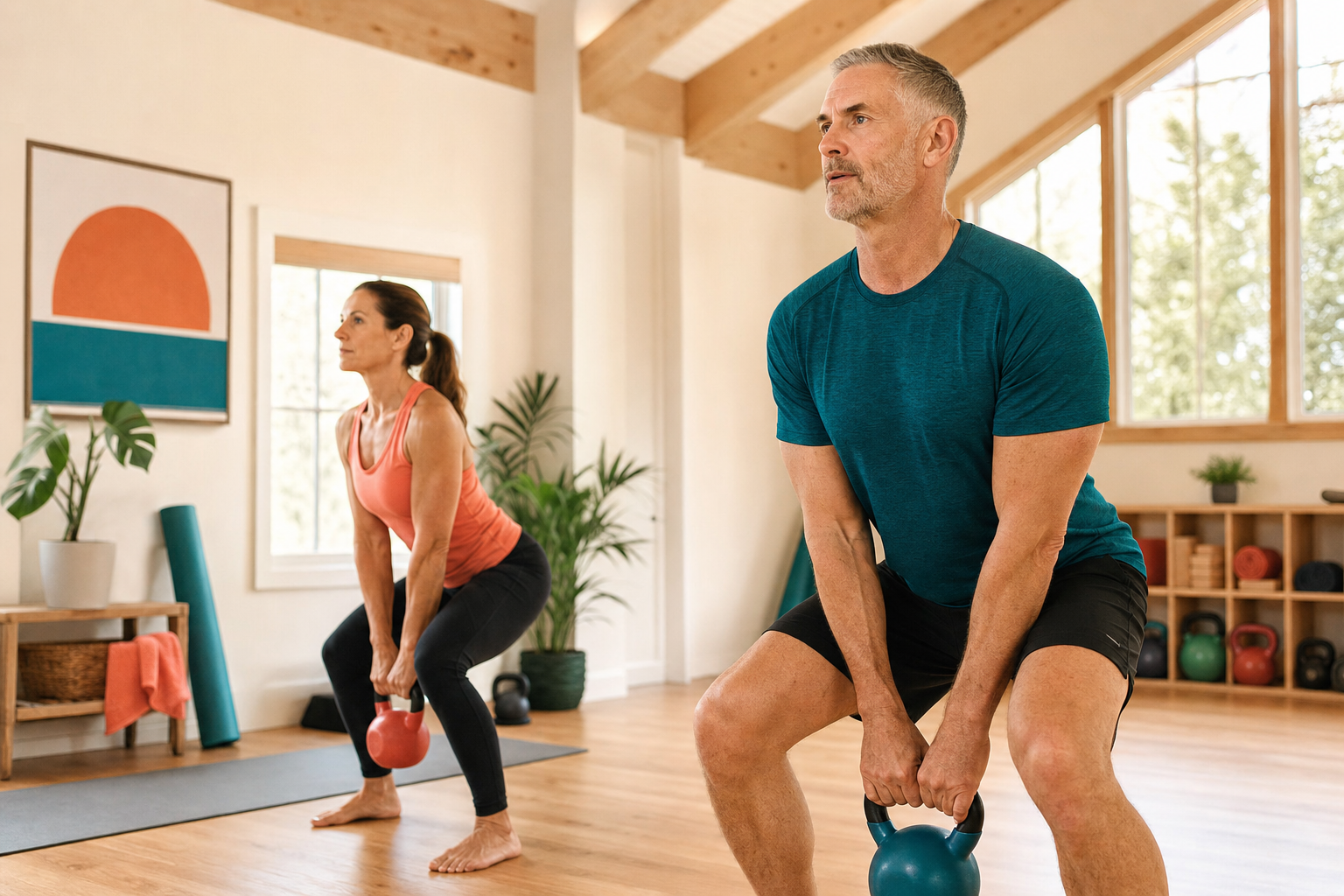
How Many Days a Week Should You Strength Train After 40? (Fewer Than You Think)
How Many Days a Week Should You Strength Train After 40? (Fewer Than You Think)
Here's what most people get wrong about strength training frequency after 40: they assume more is better, that six days a week will deliver twice the results of three, and that soreness is the scoreboard that tells you whether you worked hard enough.
The research tells a completely different story.
A 2026 analysis of 147,000+ participants found that 90-120 minutes of weekly strength training delivered the biggest longevity return — not 300 minutes, not daily sessions, but roughly two to three well-executed workouts. Separate research across 26 studies of post-menopausal women converged on the same frequency: around three sessions per week. Not because that's the bare minimum, but because that's the frequency that produces adaptation without overwhelming your recovery capacity.
After 40, recovery isn't a nice-to-have. It's where the actual training effect happens. The workout is the stimulus. The adaptation — stronger muscle, denser bone, better metabolic signaling — happens between sessions, not during them. If you're training so often that you never fully recover, you're just spinning your wheels at higher RPM.
What 2-3 Days Actually Looks Like
Two days per week is the minimum effective dose for maintaining and building strength after 40. That means two full-body sessions with at least 48 hours between them — say, Tuesday and Friday, or Monday and Thursday. You'll hit every major movement pattern twice: a push, a pull, a hinge, a squat, and some form of single-leg or core work. Each session runs 45-60 minutes. You leave feeling worked, not destroyed.
Three days per week is the sweet spot for most people with real schedules and real recovery demands. Monday, Wednesday, Friday. Tuesday, Thursday, Saturday. The exact days matter less than the consistency and the spacing. Three sessions gives you more volume to distribute across the week, more opportunities to practice movement patterns, and more margin if life derails one workout. It's enough stimulus to drive real progress without requiring you to organize your entire week around the gym.
Four or five days can work if you're splitting body parts or doing lighter accessory days, but it's not necessary for most 40-60 year-olds who want to get stronger, stay healthy, and keep training sustainable for decades. The people who thrive on high frequency are usually the ones who've been training for years, recover exceptionally well, or have the schedule and support to make it work. For everyone else, it's overkill that eventually leads to burnout, nagging injuries, or both.
Why Recovery Matters More After 40
Your body at 45 or 55 doesn't repair tissue at the same rate it did at 25. Hormonal changes — declining testosterone in men, post-menopausal shifts in women — mean your recovery window is longer. Inflammation takes more time to resolve. Connective tissue needs more care. Sleep debt compounds faster. If you're also managing a job, a family, and the accumulated stress of adult life, your nervous system is already working harder than it was two decades ago.
That doesn't mean you're fragile. It means you need to be smarter about stimulus and recovery. A well-designed program at the right frequency will produce better results than a poorly-recovered high-frequency grind. Soreness is not the goal. Muscle fatigue from honest effort — delayed onset muscle soreness, or DOMS — is normal and temporary. But if you're sore or stiff for days on end, if joints ache instead of muscles, if you dread the next session instead of looking forward to it, you're not training smart. You're just training hard, and there's a difference.
What Thrive's 6-Week Cycle Is Built Around
At The Fort's Thrive program, we structure training cycles around exactly this frequency: two or three sessions per week, depending on what fits your life. Each 6-week cycle starts with an assessment to establish where you are, not where you think you should be. From there, you follow your own program — tailored to your movement quality, your injury history, your goals — in a small group of up to six people with one coach managing the room.
You're not doing the same workout as everyone else. You're doing the workout you need, with a coach watching your form, adjusting load, and progressing you week to week. The cycle costs $360 for six weeks — roughly $30 per session if you're training twice a week, less if you're training three times. It's not a class where you show up and survive. It's coached training at a frequency that actually works for people with jobs, families, and a finite recovery budget.
The sessions are 45-60 minutes. You warm up, you lift, you leave. No 90-minute hero workouts. No weekends spent limping around because you overtrained. Just consistent, progressive, sustainable strength work that compounds over months and years.
Consistency Beats Heroics
The 40-year-old who trains twice a week for five years will be stronger, healthier, and more durable than the 40-year-old who hammers six-day-a-week programs for three months and then quits because it's unsustainable. This isn't motivational rhetoric. It's how adaptation works.
Strength is built in small, repeated doses over long time horizons. The goal isn't to punish yourself into results. The goal is to show up consistently at a frequency your body can recover from, progress intelligently, and still have energy left for the rest of your life. Two to three days per week is not a compromise. It's the evidence-based answer for most people who want to get stronger and stay strong for decades.
If you've been sitting on the fence because you think you don't have time for five or six days a week, you're solving the wrong problem. You don't need five or six days. You need two or three good ones, and a program that actually fits your schedule instead of demanding you rebuild your life around the gym.
What Happens Next
If you're ready to start — or restart — strength training at a frequency that actually works, the first step is a conversation, not a sales pitch. We'll walk through what you're dealing with, what you're aiming for, and what a realistic training week looks like in your life. No fitness test. No hazing. Just an honest assessment of where you are and a clear plan for where you're going.
Start here — it takes three minutes, and it's the fastest way to figure out whether Thrive is the right fit.
Ready to get started?
Book a free consultation and take the first step toward your goals.
Book Free Consultation