On a Weight-Loss Medication? Why Strength Training Just Became Non-Negotiable
On a Weight-Loss Medication? Why Strength Training Just Became Non-Negotiable
If you're taking a GLP-1 medication — semaglutide, tirzepatide, or any of the newer formulations — you already know they work. The weight comes off. The appetite quiets down. The scale moves in a direction it hasn't in years.
What most people don't know until it's too late: 20 to 50 percent of the weight you lose on these medications can be lean tissue — muscle, bone density, and the metabolic infrastructure that keeps you strong, balanced, and independent at 50, 60, and beyond.
That's not a side effect. That's the default outcome when rapid weight loss happens without a structured resistance training program running alongside it.
This isn't a lecture about whether you should or shouldn't take the medication. That's between you and your prescriber. This is about what happens to your body during the loss — and what you can do to protect the parts that matter most.
What Happens to Muscle During Rapid Weight Loss
When you lose weight quickly — whether through medication, severe calorie restriction, or both — your body doesn't distinguish between fat and muscle. It just sees a deficit and pulls from both.
Research presented at the Endocrine Society's 2026 meeting found something surprising: people taking GLP-1 medications actually decrease their physical activity levels during treatment. They're eating less, moving less, and signaling to their bodies that muscle isn't necessary anymore.
The result? You lose weight. You also lose strength. You lose bone density. You lose the tissue that protects your joints, stabilizes your spine, and keeps your metabolism running efficiently.
At 45 or 55, that tradeoff might not register immediately. At 65 or 75, it shows up as falls, fractures, and the loss of the ability to do basic tasks without help.
Why This Matters More After 40
Muscle isn't just about how you look. It's the organ system that determines how well you age.
After 40, you lose about 1-2% of your muscle mass per year if you do nothing to stop it. Add a GLP-1 medication without resistance training, and that rate accelerates dramatically.
Here's what that costs you:
- Metabolic rate drops. Muscle burns calories at rest. Less muscle means your body needs fewer calories to maintain its weight — which makes regaining fat easier once you stop the medication.
- Balance and stability decline. Strong legs and a stable core are what keep you upright on uneven ground, icy driveways, and stairs. Lose that strength, and your fall risk climbs.
- Bone density follows muscle. Your bones respond to the load your muscles place on them. Less muscle means less stimulus, and bone density drops alongside it.
- Independence becomes negotiable. The ability to get up off the floor, carry groceries, or travel without assistance all depend on strength you're losing right now if you're not actively training.
This isn't scare tactics. This is what the research shows happens when rapid weight loss isn't paired with resistance training.
The Prescription: 2-3 Days a Week, Supervised, Progressive
The good news: strength training during GLP-1 treatment preserves lean mass. A 2025 study presented at the European Congress on Obesity found that participants who followed a supervised resistance training program maintained significantly more muscle during weight loss than those who didn't train.
Here's what that looks like in practice:
- Two to three sessions per week. More than that isn't necessary; less than that doesn't protect muscle effectively.
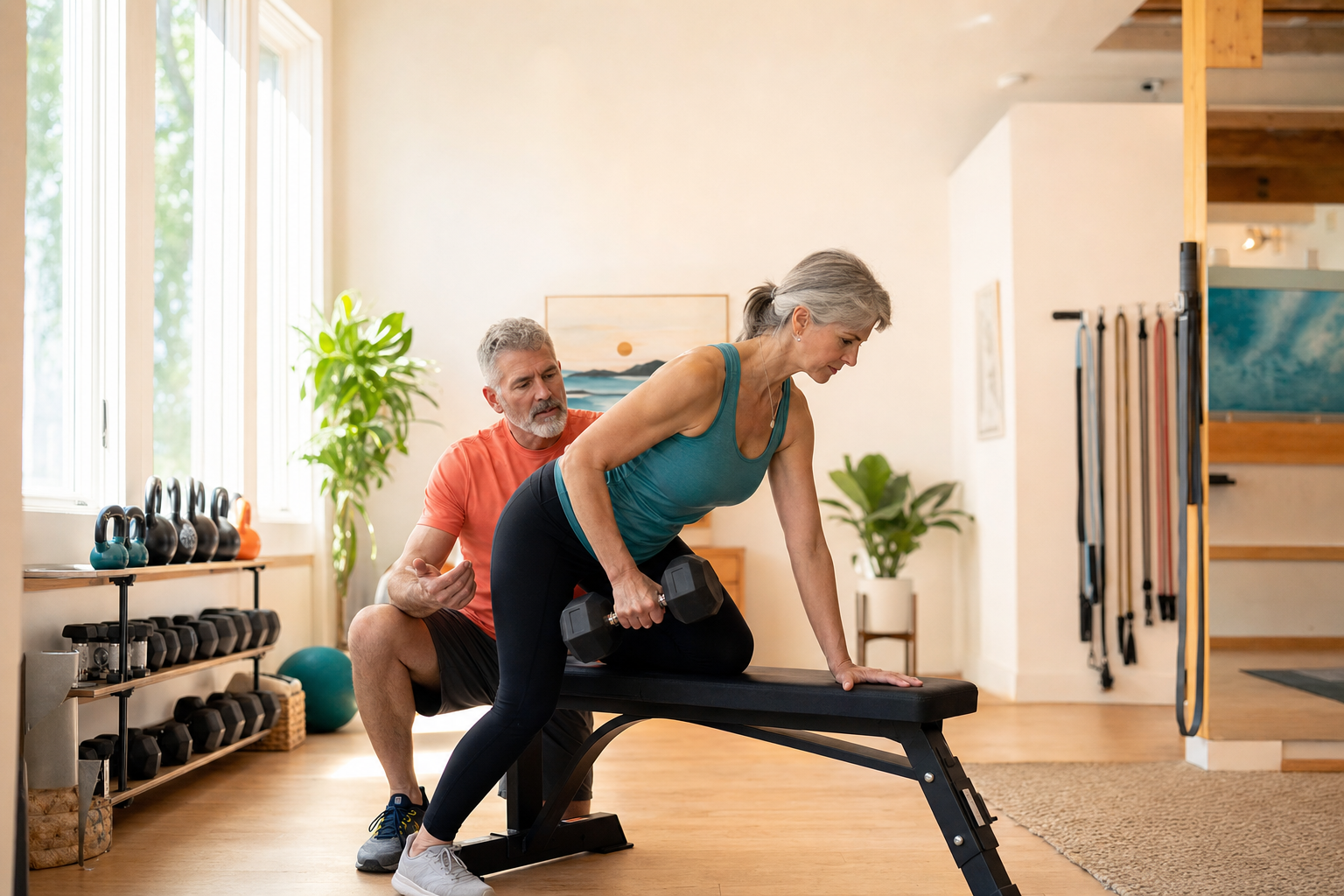
- Supervised coaching. This isn't the time to guess. You need someone watching your form, adjusting load, and making sure you're actually challenging the muscle — not just going through motions.
- Progressive resistance. The weight needs to increase over time. Your body only keeps the muscle it's forced to use.
You don't need to become a powerlifter. You need to squat, hinge, push, pull, and carry load consistently enough that your body decides the muscle is worth keeping.
Your Prescriber Handles the Medication. We Handle the Muscle.
This is the explicit division of labor:
Your doctor or prescriber manages the medication, the dosage, and the medical side of your weight loss. That's their lane, and they're the expert.
Our lane at The Fort is the muscle. We assess where you're starting, design a program that fits your current strength and movement capacity, and coach you through the two to three sessions per week that research says protect lean mass during rapid weight loss.
If you've never lifted before, that's fine. Most people walking through the door at 45 or 55 haven't. The whole point of supervised training is that you don't need to know what you're doing yet — you just need to show up and let someone who does know guide the process.
What a First Session Actually Looks Like
No fitness test. No baseline weigh-in. No performance hazing.
You'll meet with a coach who'll ask about your injury history, what movements feel difficult right now, and what your goals are beyond the number on the scale. Then you'll move through a handful of foundational patterns — squat, hinge, push, pull — so the coach can see where you're starting and what needs attention first.
From there, the program builds week to week. The weight goes up gradually. The movements get more complex as your capacity improves. And six weeks later, you're stronger than you were at the start — not just lighter.
That's the goal. Not smaller. Stronger.
What Happens If You Don't Train
You lose the weight. You also lose 20 to 50 percent of your muscle. Your metabolism slows. Your balance declines. Your bone density drops.
And when you stop the medication — whether that's in six months or two years — you're left with a body that's weaker, less stable, and more prone to regaining fat than it was before you started.
That's not a moral judgment. That's just the biology of rapid weight loss without resistance training.
Start Here
If you're currently taking a GLP-1 medication and you're not training, this is the gap that needs closing. The medication works. The weight comes off. But without a structured resistance program running alongside it, you're losing more than fat.
We're not anti-medication. We're pro-muscle. And if you're serious about keeping your strength, balance, and independence intact during this process, book a free consult and we'll figure out what the next six weeks should look like.
Your prescriber handles the medication. We handle the muscle. That's the deal.
Ready to get started?
Book a free consultation and take the first step toward your goals.
Book Free Consultation