Will Lifting Weights Make Me Bulky? What Actually Happens When Women Over 40 Strength Train
Will Lifting Weights Make Me Bulky? What Actually Happens When Women Over 40 Strength Train
Here's something most women don't know: the hormonal environment required to build substantial muscle mass shifts dramatically after 40, and it shifts in a direction that makes accidental bulk essentially impossible.
Testosterone — the primary hormone responsible for muscle hypertrophy — peaks in women around age 20 and declines steadily from there. By menopause, women produce roughly 50% less testosterone than they did in their twenties. Estrogen, which plays a supporting role in muscle protein synthesis, drops even more sharply during the perimenopausal transition. The biological machinery required to add significant size simply isn't operating at the levels it once was.
Yet the fear persists. Women walk into strength training facilities every week worried they'll wake up unrecognizably muscular after a few months of lifting. The question deserves a straight answer, and the answer is rooted in physiology, not opinion.
What the Hormone Numbers Actually Mean
Professional female bodybuilders — the women whose physiques fuel the "bulky" concern — train with extraordinary volume (often 10-15+ hours per week), follow strict hypertrophy-focused programming, eat in a calculated caloric surplus, and in many cases use performance-enhancing drugs that raise testosterone to supraphysiological levels. That outcome requires deliberate, sustained effort in every variable.
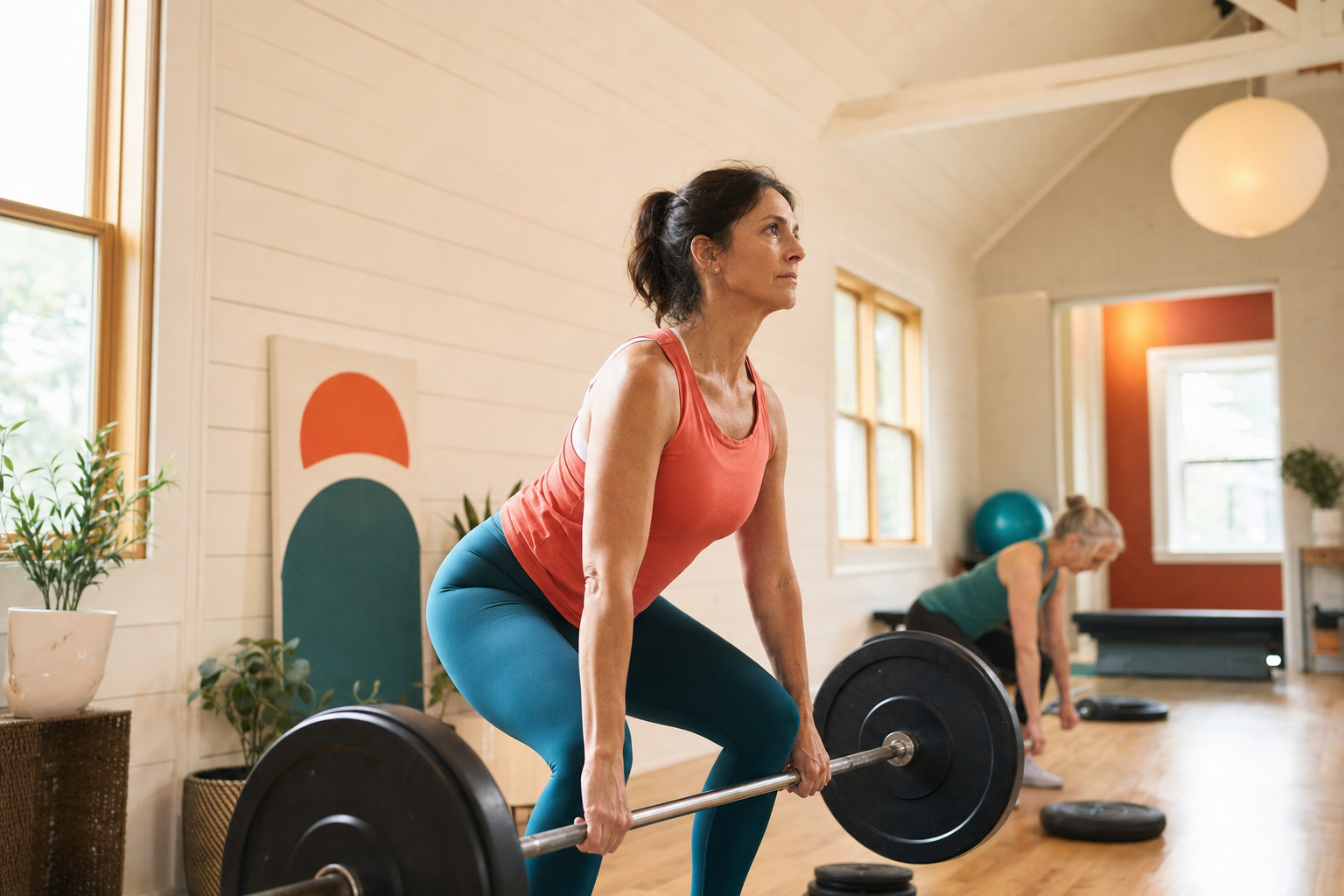
The typical woman over 40 strength training 2-3 times per week for 45-60 minutes per session is operating in a completely different physiological context. Her testosterone levels are a fraction of what a younger woman produces, let alone what a competitive bodybuilder sustains. Her training volume is nowhere near the threshold required for hypertrophy-dominant adaptation. And unless she's eating in a significant caloric surplus — which most women over 40 are not — her body has no raw material to build substantial new tissue.
What happens instead is recomposition: modest muscle gain (typically 2-4 pounds over several months), simultaneous fat loss in many cases, and a visible change in how the body holds itself and moves. Clothes often fit differently — frequently better in the shoulders and worse in the thighs, or tighter in the back and looser in the waist. Posture improves. Daily tasks that used to require thought or assistance become automatic.
None of that registers as "bulky" to the person living in the body. It registers as capable.
The Toning Myth We Can Retire
The word "toning" deserves a quiet retirement. It suggests a separate category of training — lighter weights, higher reps, some vague firming effect — that will sculpt muscle without adding size. Physiologically, there's no such process. Muscle either grows in response to progressive mechanical tension, or it doesn't. What people describe as "toned" is simply muscle that's visible because there's less subcutaneous fat obscuring it, or muscle that's developed enough to create definition under the skin.
The training that builds strength and the training that changes body composition are the same training. Progressive overload — gradually increasing the demand on the muscle over time — is the mechanism. The weight on the bar goes up every few weeks not because the coach is trying to make you huge, but because your nervous system has adapted to the current load and your muscle fibers need a new stimulus to continue responding.
In a coached program like Thrive semi-private personal training, that progression is managed for you. You're not guessing whether to add five pounds or stay at the same weight; your coach has tracked your performance and knows when the jump is appropriate. The result is consistent, sustainable progress without the risk of stalling or overreaching.
What Women Actually Report After 12 Weeks
When we talk to women three months into a strength program, the feedback clusters around a few themes:
Posture changes first. Shoulders pull back, head sits more naturally over the spine, the chronic forward slump from desk work or childcare years starts to unwind. This happens because the posterior chain — upper back, glutes, hamstrings — finally has enough strength to counterbalance the anterior dominance most of us develop from modern life.
Daily strength shows up in surprising places. Carrying groceries, lifting a suitcase into an overhead bin, getting up off the floor without using hands, playing with grandchildren without lower-back fatigue. These aren't gym metrics, but they're the ones that matter in real life.
Clothes fit differently, and it's not always predictable. Jeans might feel tighter in the quads and glutes while the waistband sits looser. Shirts pull across the upper back or shoulders in a way they didn't before. Some women go up a pant size while dropping two shirt sizes. The scale often stays roughly the same or moves very little, which confuses people who were told to track weight as the primary success metric.
Confidence shifts. This one is harder to measure but near-universal. Women report feeling more solid, more grounded, more willing to try new physical challenges. The psychological effect of knowing your body can do hard things — and will get better at them with practice — extends beyond the gym.
None of these reports include "I got bulky and hate how I look." That outcome, in our experience with women over 40, doesn't happen by accident.
Why Progressive Overload Isn't Optional
Here's the part that sounds counterintuitive: if you want to avoid the frustration of training without results, you need to progressively add load over time. Lifting the same 10-pound dumbbells for months on end won't make you bulky, but it also won't do much of anything. Your body adapts to a stimulus and then stops responding unless the stimulus changes.
Progressive overload doesn't mean reckless jumps or training through pain. Pain — sharp, joint-localized, or radiating — is never a signal to push through; it's a signal to stop and assess. Muscle fatigue and delayed-onset soreness (DOMS) after a hard session are normal and expected. Lingering joint pain or sharp discomfort during a movement are not, and they warrant a conversation with your coach or a visit to Performance Therapy with Dr. Molly Sifflard, DPT, who specializes in keeping lifters training without injury.
What progressive overload does mean is that the weight, volume, or complexity of your training increases gradually over weeks and months. In a Thrive cycle, that might look like moving from a goblet squat to a front squat, or adding 10 pounds to your deadlift over six weeks, or completing an extra set at the same load. The progressions are individualized because every person in the group is following their own program, even though they're training in the same space at the same time.
That structure — individual progression within a small group — is what makes semi-private training effective for this demographic. You're not bored by a program that's too easy, and you're not injured by a program that's too aggressive. You're challenged at your edge, and your edge moves every few weeks.
The Real Question Under the Question
When someone asks, "Will lifting make me bulky?" the real question is often, "Will this change my body in a way I don't want?"
The honest answer is: yes, strength training will change your body. Your muscle will grow modestly. Your posture will improve. You'll move differently. You'll carry yourself differently. Some clothes will fit differently.
But the fear that you'll wake up one morning unrecognizably muscular after a few months of training twice a week? That's not supported by physiology, and it's not borne out in the lived experience of the thousands of women over 40 who've picked up a barbell in the past decade.
What is supported — by both research and experience — is that strength training after 40 is one of the most effective interventions available for maintaining independence, reducing injury risk, and building a body that works better in the second half of life.
If you've been sitting on this question for months or years, it might be time to answer it with direct experience rather than speculation. We offer a free discovery process that helps you figure out where to start, whether that's Thrive, one-on-one coaching, or another format entirely. Start here and we'll take it from there.
Ready to get started?
Book a free consultation and take the first step toward your goals.
Book Free Consultation